

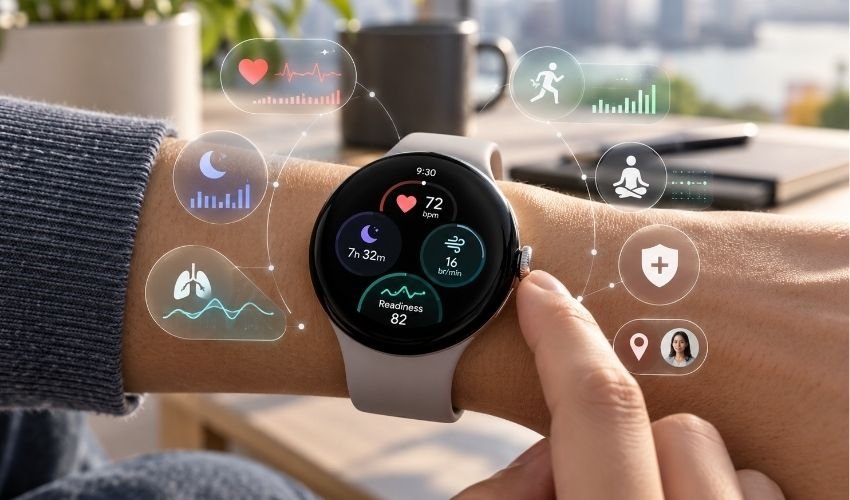
A smartwatch used to have a simple job. It told the time, counted steps, and showed phone alerts. That idea is changing fast. The Google Pixel Watch is now moving into a much bigger role. Google wants the watch to help people notice changes in their health before those changes are easy to see.
The Pixel Watch 5 is a clear example of this shift. It still tracks workouts, heart rate, sleep, and daily movement. But it also adds tools that look at longer health patterns. These tools can show changes linked to blood pressure, sleep breathing, and metabolic health.
The watch can even look for a serious breathing emergency in supported regions. This does not turn the Pixel Watch into a doctor. It does show how wearable technology is moving from simple fitness tracking toward daily health awareness.
The Google Pixel Watch Is Moving Beyond Step Counting
Step tracking helped make smartwatches popular. Many people liked seeing how far they walked each day. Heart rate tracking then became another common feature. Sleep data, workout tracking, and calorie estimates followed.
These tools are still useful, but the Google Pixel Watch is now trying to do more. Pixel Watch 5 introduces Google’s Health Guardian tools. These tools work in the background and study patterns over time. The goal is not only to tell you what happened during one workout.
The goal is to help you see when your normal health pattern may be changing. Google says Health Guardian can track trends linked to blood pressure, insulin resistance, and sleep breathing quality. That changes the role of the watch. Instead of only asking, “How many steps did I take today?” a user may start asking, “Has something in my body changed this month?”
What Health Guardian Means
The name Health Guardian sounds large, but the basic idea is easy to understand. The Pixel Watch gathers signals while you wear it. Google uses these signals and its health models to find patterns. Some of those patterns may not be easy for a person to notice alone. The results can then appear in the Google Health app.
Google says the system works with data gathered across days and weeks. It does not depend only on one reading. This is important because the human body changes all the time. Heart rate may rise during exercise. Sleep may change after a stressful day. One unusual reading may not mean much. A long pattern can sometimes be more useful. Health Guardian is designed to make those longer patterns easier for users to understand.
As of September 2026, Google said Health Guardian tools were rolling out in the Google Health app. Pixel Watch users could begin setting up blood pressure trends, insulin resistance trends, and sleep breathing information. Google said these tools would be available on Pixel Watch 3, 4, and 5, although availability can change by country and device. The first trend reports require enough wear time and data. This means the watch is not designed to give a full long-term health story after only one day on your wrist.
Blood Pressure Trends Without a Normal Cuff
Blood pressure is often checked with a cuff around the arm. The Google Pixel Watch does not replace that normal medical test. Instead, Health Guardian looks for blood pressure trends using pulse and movement information gathered over time. Google says the feature is meant to help users notice longer changes in cardiovascular wellness. It does not give the same kind of real-time blood pressure number that you would get from a medical cuff. That difference matters.
A person may see that their pattern has moved higher than usual. That information could give them a reason to pay more attention to their daily habits or use a proper home blood pressure monitor. It could also give them useful information to discuss with a health professional. However, users should not change medicine or treatment because of a Pixel Watch trend. Google clearly says these tools are for general wellness and information. They are not designed to diagnose high blood pressure.
This is a good example of why the Google Pixel Watch is becoming more than a normal fitness tracker. A step counter tells you what you did. A trend system tries to show how your body may be changing. That can make the watch feel more useful even on days when you do not exercise.
A New Look at Metabolic Health
Another Health Guardian feature looks at insulin resistance trends. Insulin helps the body use energy from food. Problems with insulin response can be linked to poor metabolic health. In the past, people may have thought about this type of information mainly during medical testing. Google is trying to make long-term metabolic trends easier to see through wearable data.
The Pixel Watch does not take a blood sample. It also does not diagnose diabetes. Instead, Google’s system studies many signals over time and looks for changes in a person’s normal pattern. Google says the feature uses multi-week data and shares trend information through the Google Health app. The company also says this information should not be used as a medical test or as a reason to change treatment.
The benefit may be awareness. Many people do not think about metabolic health every day. A watch can make the subject easier to notice because it is already on the wrist. If a user sees a change, that may encourage better questions about sleep, food, exercise, or a visit to a health professional. The value is not that the watch knows everything. The value is that it may help the user notice a pattern that they would otherwise ignore.
Sleep Is Becoming a Bigger Part of Health Tracking
Sleep has been part of smartwatch tracking for years, but the Google Pixel Watch is making breathing during sleep a bigger part of the picture. Health Guardian includes a sleep breathing quality tool. It looks at how breathing changes during sleep and gives users information about their normal pattern.
This can matter because a person may sleep for many hours and still wake up tired. Sleep quality is not only about time in bed. Breathing, movement, stress, and many other factors can affect how rested a person feels. Google’s feature aims to show how much of a user’s sleep had what it calls optimal breathing. Over time, the app can also show a wider trend.
Again, this does not mean the Google Pixel Watch can diagnose sleep apnea or another sleep disorder. Google says the breathing quality tool is for general wellness. It is not a medical screening test. But the information may help people notice that their sleep pattern has changed. That can lead to better habits or a useful talk with a doctor.
Breathing Emergency Detection Is a Bigger Safety Step
One of the most serious new features is breathing emergency detection. Google says this feature is available on Pixel Watch 4 and Pixel Watch 5 in certain European countries. It is an opt-in tool. It is designed to look for a severe and lasting drop in oxygen saturation that could happen during certain breathing emergencies.
The system uses information from several sensors. Google says it looks at heart rate, movement, and altitude information with an AI-based system. If the watch thinks a breathing emergency may be happening, it first tries to get the user’s attention. It uses vibration and a screen alert. If the person does not respond, an audible alert and countdown can follow. In supported situations, the watch can then try to contact emergency services and emergency contacts.
This feature shows why calling the Google Pixel Watch only a fitness tracker no longer tells the full story. A fitness tracker helps you study a run. A safety-focused wearable may try to help when you cannot call for help yourself.
There are also important limits. Google says breathing emergency detection may not catch every emergency. It depends on working call functions and a suitable connection. It also is not designed for some users, including people with certain existing respiratory conditions and pregnant users. The feature has not been cleared or evaluated by the U.S. FDA, and availability is limited by region.
Four Ways the Watch Now Helps With Health Awareness
The health shift can be understood through four main areas:
-
Long-term patterns: The watch can look at changes across many days instead of showing only one reading.
-
Sleep awareness: Users can see more information about breathing quality during sleep.
-
Metabolic awareness: Trend tools may help users notice changes linked to insulin resistance.
-
Emergency support: In supported areas, the watch can look for signs of a serious breathing emergency and try to call for help.
These tools do not make the watch a hospital on your wrist. They do make it a more active part of daily health awareness.
AI Is Helping the Watch Understand Patterns
Artificial intelligence is an important part of this change. Google says its health models were trained using very large sets of sensor information from users who agreed to share data for research and development. These models are built to study patterns that may be hard to see from one sensor reading.
This is different from a simple rule such as “10,000 steps is good.” Human health is more complex. A person’s normal resting heart rate may be different from another person’s. Sleep can also change from one person to another. AI can study more signals at the same time and compare them across longer periods.
Pixel Watch 5 also uses Gemini features for general smartwatch tasks. But health AI has a different job. It is meant to turn large amounts of sensor data into information that is easier for the user to understand. Google says its Health Guardian models have been tested against clinical measurement methods, but the company still warns that the resulting wellness information is not a diagnosis.
Why Passive Tracking Can Be Useful
One surprising benefit of the Google Pixel Watch is that the user does not have to remember to take every measurement. A traditional health routine may require a person to stop, find a device, take a reading, and write down the result. A wearable can gather some information while the person works, walks, rests, or sleeps.
This passive tracking may make long-term patterns easier to see. People often forget small changes. They may not remember that sleep became worse three weeks ago. They may not notice a slow change in resting heart rate. A wearable keeps a record.
There is still a problem, though. More data is not always better. A person can become worried if they treat every small change like a medical emergency. That is why clear explanations are important. The watch should help people understand their health, not make them afraid of every number.
The Google Pixel Watch Cannot Replace a Doctor
This is the most important point in the whole article. The Google Pixel Watch is not a doctor. Health Guardian features do not diagnose disease. Blood pressure trends are not the same as a medical blood pressure reading. Insulin resistance trends are not a diabetes test. Sleep breathing information is not a sleep apnea diagnosis. Google makes these limits clear in its own product information.
A smartwatch can point to a possible change. A doctor or other trained health professional can decide what that change means. Medical tests can also give information that a watch cannot collect.
The best way to think about the Pixel Watch is as an extra source of information. It can help a person see patterns between doctor visits. It can also help users describe what they have noticed. For example, instead of saying, “I have felt tired lately,” a person may also be able to show that their sleep pattern changed during the same period.
That can make a health conversation more useful, but it does not replace professional care.
Health Features May Change Why People Buy Smartwatches
For years, smartwatch marketing focused heavily on exercise. Ads showed people running, cycling, lifting weights, and closing activity goals. Those things still matter. Pixel Watch 5 includes fitness tools and improved GPS tracking. But health and safety may now become stronger reasons to buy a smartwatch.
A runner may want workout data. An older user may care more about heart and safety tools. A busy worker may want sleep information. Someone with a strong interest in wellness may care about long-term trends. This wider set of uses means the smartwatch market is changing.
It also creates more responsibility for companies. When a device talks about health, users may trust it more than they trust a normal gadget. Companies need to explain what their tools can and cannot do. They also need to make results easy to understand.
There Is Still a Privacy Question
More health tracking also means more health data. That creates an important question: how comfortable are people with a technology company studying information about their bodies?
Heart rate, sleep, breathing, activity, and metabolic trends can feel more personal than a normal app notification. Users should understand what information is collected, where it appears, and which settings they can control.
This does not mean health tracking is bad. It means users should make an informed choice. A useful health feature must also earn trust. As smartwatches become better at understanding the body, privacy and data control will become a larger part of the buying decision.
A Small Watch Can Create Better Daily Habits
The biggest benefit of the Google Pixel Watch may not be one special sensor. It may be the way the watch makes health harder to ignore.
A person sees the watch many times each day. That makes it a natural place for small reminders and simple health information. A sleep trend may encourage an earlier bedtime. Exercise data may encourage a short walk. A change in a long-term wellness trend may lead someone to check their health with a proper medical tool.
These are small actions. Yet small actions repeated over time can matter.
The goal should not be to watch every number all day. The better goal is to use the data when it adds value. Technology works best when it helps people make a clear choice and then lets them return to normal life.
From Fitness Tracker to Health Companion
The Google Pixel Watch shows where wearable technology may be heading next. Step counting and workout tracking are no longer enough to define a modern smartwatch. Pixel Watch 5 combines fitness data with sleep information, health trends, safety tools, AI, and emergency features.
Health Guardian is at the center of that change. It looks at longer patterns instead of only single moments. Blood pressure trends can provide general cardiovascular awareness. Insulin resistance trends can offer another view of metabolic wellness. Sleep breathing tools can help people understand how breathing changes at night. Breathing emergency detection can add another safety layer in supported countries.
These features are powerful, but they must be understood correctly. They are tools for awareness. They are not medical diagnoses. They should not replace a doctor, medical test, or emergency care.
Final Thoughts
The Google Pixel Watch is becoming much more than a device that counts steps. Pixel Watch 5 shows Google’s push toward a smartwatch that watches for long-term health patterns and, in some cases, serious safety events.
That shift may change how people think about wearable technology. The question is no longer only, “How many steps did I take?” It may also become, “What has changed in my body over time?”
That is where the idea of a personal health guardian becomes useful. The watch cannot promise perfect health. It cannot diagnose every problem. But it can help people notice patterns, learn more about their daily habits, and know when information may be worth discussing with a health professional.
For the Google Pixel Watch, that is a major step forward. The device is still a smartwatch and fitness tracker, but its growing health tools show a future where the technology on our wrists may play a much bigger role in helping us understand our bodies.
